Learn to Lead Podcast: How to Have “Questioning Leadership” with Liz Kislik
I’m going to kick us off with a recent article that you wrote for Forbes that described a magic ingredient for leaders’ success. Can you start us off by telling us what that magic ingredient is and how leaders can cultivate it?
This comes from a book by Marilyn Gist, and the magic ingredient is humility. It’s so important because we’ve all had the unfortunate experience of working for a leader who thought it was about them. Whenever that’s the case, and when the leader’s ego takes up too much room, it’s actually harder to get the work done. That’s true whether you’re talking process stuff or collaboration, the leader needs to know how to step back and have the work be what’s important.
I want to dive in a little bit more to that. I want to start by talking a little bit about your origin story. How did you originally get so interested, broadly, in the topic of leadership development, and maybe more functionally, what was the process that you took, for lack of a better way to describe it, to find your why and figure out that this is what you wanted to do and talk and write about?
I guess they’re intertwined. I really didn’t like it when stuff wasn’t getting done well. It would frustrate me, and I would be upset if things didn’t go well. That was true. Maybe it’s a birth order issue. I’m an eldest child. Maybe it is just feeling responsible for things. As early as a little kid, I can remember wanting things to go well and wondering how I could make them do that, make things better.
Propel your
leaders to their
potential todaySchedule time to discuss your organization's development goals with one of our experts.
“Abilitie doesn’t have a ‘one-size fits all’ offering. Their ability (pun intended) to adapt to our needs in such a short amount of time highlights the flexible nature of their product design and construct. As a client, that’s a highly valuable attribute of their offering.”
In my own journey to leadership development, most of this stuff happens haphazardly and by luck, good luck and bad luck. I didn’t like when things weren’t getting done so I would often volunteer or step up to take on more responsibility. That led to a couple of things. One was learning that you can overload yourself and burn out and not do as well as you should. The other is learning that it is not natural to everybody to be willing to make hard decisions or have tough conversations. Those things take practice. They’re very challenging and many people shy away from them.
I want to talk a little bit more about those hard conversations. You’ve done an extensive amount of work with leaders over the years. I know we hit on humility to kick it off. If I was going to throw a hypothetical at you personally, and you were just about to start working with a brand new leader, and you could give them one or two traits, well, obviously throw humility in there, what other sort of traits should current and future leaders be looking to cultivate, and if you want to take it a step further, how would you suggest that they do that?
Okay, that is a very big question. The first thing I would say is that, in fact, when I’m working with a new leader, I would never presume to tell them what traits were necessary or which ones they needed more of. I don’t actually think that’s helpful.
I think the thing that’s helpful is to find out what’s working for them and what’s not working for them. Some of that is by asking them and some of it is by observing them. Sometimes, you get the opportunity to actually find out from their colleagues and subordinates and their own leaders what works and what doesn’t work for them. From that exploration, then you can think about ways to help them see what would work better for them.
In general, blanket statements about what somebody needs can be really off-putting. It feels like you’re making a judgment that the person is not adequate the way they are. They may, in fact, not be skillful enough, but most people, not everybody, really wants to do well, really wants to make success for everybody. Starting off by telling them that they’re not good enough is rarely helpful.
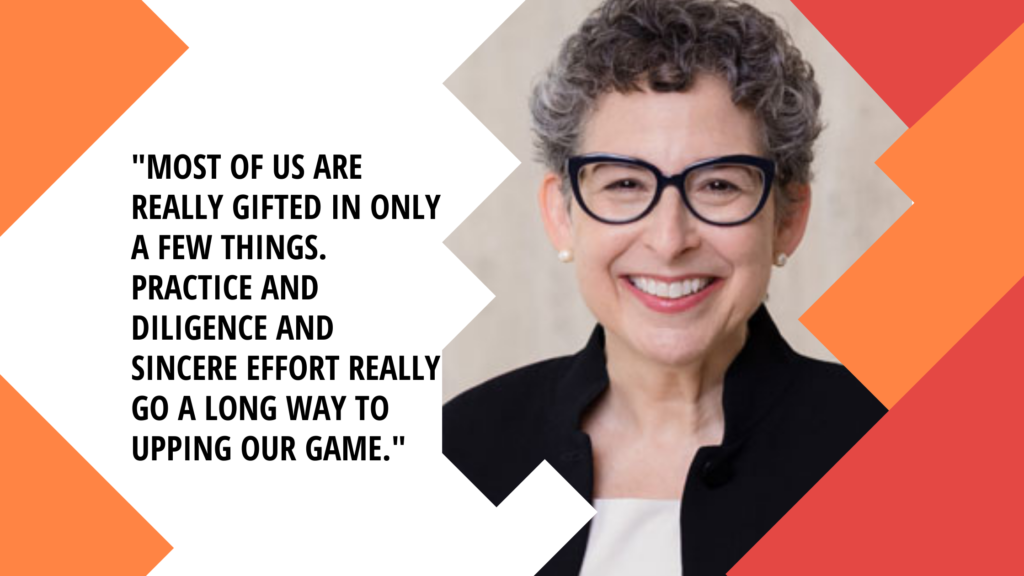
Most of us are really gifted in only a few things. Practice and diligence and sincere effort really go a long way to upping our game.
Things that I would want to work with leaders on have to do with a kind of curiosity, which is probably the most important thing to me to be able to ask questions about why things are, whether they’re good or bad, because just taking things as they are means we don’t learn so much and being able to question even what’s good, not to find fault with it but to learn about how it happened, I think that’s crucial. That’s probably one of the first.
The second thing as an underlying support for almost everything else is actually compassion. Because any leader who does not care about other people ends up making inaccurate decisions, implementing them poorly, and often having loads of trouble because employees don’t want to stay, customers are dissatisfied, et cetera.
Wondering about how things got to be the way they are and what could be better is absolutely crucial and caring about the people who are involved every step along the way and from every side. Those two things.
If you got those, you can learn most other stuff.
I really like that answer. Something that you said that really resonated with me is asking “What is working for you and what isn’t working for you.” What do you wish you knew about this industry when you started out? We’re all on this process of learning and personal discovery. What do you wish you knew about the fields or maybe even about yourself as a leader when you started out on your journey?
I’m laughing because what I wish I knew for myself is that you can screw things up and redeem yourself and keep going because, when you’re young and new to leadership, you’re so terrified of screwing up. You carry some of that with you because this goes back to the humility issue.
The more responsibility you have, you have to be conscious that there’s more damage you can do if things go wrong to people, to organizations, et cetera. I’m not saying that the fear all goes away. Knowing in the beginning that people really have a lot of tolerance, and if you apologize sincerely and work to do better, most of them forgive you when you mess things up. You can even forgive yourself, as you see that you can overcome certain hurdles. I think that’s what I wish I would have known instead of self-torturing so much.
Well, I’ve had the pleasure of asking a lot of our guests a similar variant of that question. I’ve heard that theme before, and I really like the way that you structured it. It definitely resonates with me as something that I would probably tell my younger self.
Now I want to take the conversation in a slightly different direction, because a question that we get frequently from listeners talks specifically about productivity and how individuals can manage the requirements on their plate and thrive in those environments.
A post that you did on your blog that drew a lot of attention and it caught my attention as well, was focused on handling a rising workload as you move up at an organization. Can you talk a little bit about how individuals can juggle more and more priorities and responsibilities in a successful manner as they move up at an organization?
The first thing is making sure you actually understand what your new responsibilities are. What are you there to do? Why were you put in this job?
That kind of clarity is often hard to get but going back to whoever your leader is, and having a real dialogue about it, and making sure that the two of you are on the same page so that you can go forward with a kind of confidence about what the accomplishments need to be because without that sense of scope, it’s very hard to figure out how to apply your energies against it. That’s a baseline thing.
For all leaders who are moving up, one of the most important things is to figure out how to share the load because there are ways in which you never get to let go of things you were considered expert at or responsible for. People remember that you were the one who had the magic answers in a certain area and they tend to come back to you. It is unbelievably important to engage your team. That may actually be two teams if you’re leaving your old team and going to a new team or it may be just that you have the same team.
Either way, it’s being clear with people about what you’ll be working on now and what your responsibilities are, and the ways in which you hope and wish to work with them so that they can step up to handle more responsibilities as well. That requires a combination of understanding what their work is, and being clear with them about what you expect and also being clear with them that it’s not like you’re flipping a switch and expecting them to be different today, “I’ve been moved so now all of a sudden, your job is different.” That’s not very helpful, but understanding that there is a process that you’ll go through together to re-evaluate what the work is and the best ways to share it out.
Some of that is delegation. Some of that’s assignment, some of that’s collaboration and figuring it out together but it’s about really engaging the team and not just thinking, “Oh, there’s more for me to do.”
I really appreciate the way that you structure it for the individual, but then also how the individual can communicate with their team.I wanted to close before flipping to our final two rapid-fire questions by just asking you a question about what you’re the most curious about right now? It can be in your space, it can be outside your space, it can be something that we’ve already hit on, or something that you maybe have planned for a future article.
Given where we are in the world what are you the most curious about going forward in the field of leadership or outside of that field?
Right now, I’m really curious about how you change minds, about how you get people to be willing to consider an opinion other than the one they already hold. There’s a lot written on this.
I think the practice is harder than we give it credit for and it takes more application. I’m really curious about trying to figure out, not only if there’s a good methodology for it but if it can be applied consistently to lots of different kinds of people.
I love that. I think it’s a perfect space to shift to our final two rapid-fire questions that I get to ask all guests. I’m really curious about your answers. Question number one is this. If you could describe your personal leadership style in one word, what would that word be?
I have to say, I think it would be questioning. My clients comment a lot about the questions I asked them, and sometimes it’s because I want to know something and sometimes it’s because I’m actively leading the witness. I think I have a questioning style.
The final rapid-fire question is this: what is the best piece of advice that you have ever received?
I think, and this is really in regard to my work and it comes from the owner of the company I worked for before I went out on my own, I was surprised when he told me this, and I didn’t believe him in the beginning but boy, has that turned out to be true. You really have to treat everybody as the individual they are.
Sometimes you need consistency, you may need rules that apply generally but in interacting with people, you have to recognize that everybody is an individual and they need something different.
—
This interview has been edited for clarity.Learn more about Abilitie’s offerings here.
More Stories
Learn to Lead Podcast: Managing Energy with Molly Fletcher



)
)